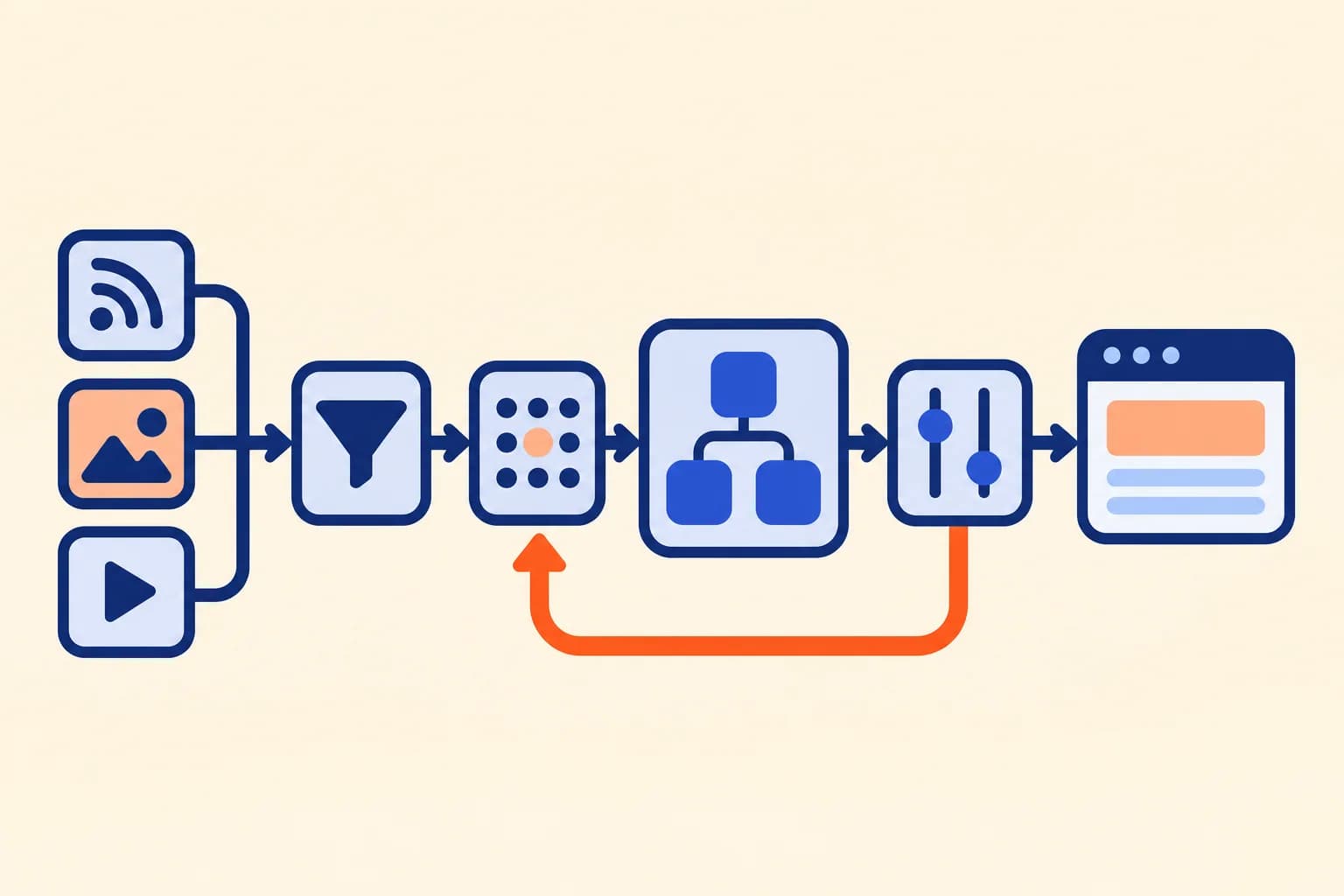
Content operations include many tasks beyond writing: finding sources, checking whether a topic is already covered, extracting text, choosing an angle, reviewing claims, and delivering a draft with references. Content Factory connects those tasks to Newstools Suite and the CMS so that every step leaves a result and a visible state.
Selection and discovery
The workflow starts with a list of candidates. Suite collects configured sources, analyzes relevance, and groups related articles. An editor can select an article or a group of sources. Selection rules can also be configured with volume limits and quality criteria.
The decision to produce a piece remains separate from its execution. This keeps the queue reviewable, allows editorial criteria to change, and lets a team pause dispatch without losing the candidates it has already found.
Check before spending
The bridge collects the queue, checks duplicates, and verifies that enough source text is available. Deduplication uses original references and semantic comparison with previous content. If text is missing, extraction can be prepared before the candidate enters generation.
One usable source supports a single-source workflow; several can support a multi-source synthesis. Available data determines which route is possible. A headline alone is not treated as if it contained a complete investigation.
Generation through specialized steps
Suite handles production through background jobs. Quality workflows include planning, drafting, pre-review analysis, style adjustments, claim checks, and editorial evaluation. Models and prompts can be configured by module to adapt the workflow to the organization.
Enrichment adds context from approved sources and preserves references. Checks also look for leftover instructions, incomplete references, and other problems that may appear in generated text. Each result must be reviewed against the defined editorial standard.
Controls before delivery
Each organization's policy decides which checks are mandatory. An editorial gate and AI detection signals may be part of that policy. A missing required check keeps the work pending or blocked for review in the configured workflow.
AI detection is probabilistic and does not establish who wrote a text. It serves as a signal alongside quality, sources, quotations, and human review. The policy must distinguish an unfavorable finding from a provider that returned no finding at all.
Delivery and traceability
Connectors and n8n normalize content and deliver it to destinations such as Strapi and tracking records. The editorial workflow we have implemented delivers drafts for review and later scheduling. It retains the relationships between candidate, sources, generation, and destination, along with states and block reasons.
Reconciliation identifies work whose delivery did not complete. Recovery routines check what already exists before resending, to reduce duplicates. The panel helps the team find where a piece stopped without repeating the whole pipeline or losing its source context.
Expand through modules
Images, voice, video, and social distribution can be added with their own providers and acceptance criteria. These extensions require setup, usage rights, and workflow validation. An implementation can start with a controlled text process and add formats once the results and the operation are ready. The project defines which modules are active and who approves their output.